

Short version: this is my fifth fall making napa cabbage kimchi. The first three years went wrong, each in a different way, and the last two came out the way I wanted. Back then I made one big glass jar. Now I make several and give most of them away to my neighbors. Below are the steps I use now, the three mistakes that taught me those steps, and this year’s notes. If you’ve never made kimchi, I hope my mistakes save you a year or two.
A little background first. In Korea, late fall is kimjang season. Families get together and make enough kimchi to last through the winter, and in 2013 UNESCO added the custom to its list of cultural heritage. Mine is a much smaller version, but it has started to feel a little more like the real thing since the jars began going next door. Every November the Korean grocery store I shop at stacks boxes of napa cabbage by the door, and when I see them, I know it’s time.
About those neighbors. When I started, a couple of them made faces at the fish sauce smell drifting out of my kitchen. These days they ask when this year’s batch will be ready, what goes into it and why it turns sour. I didn’t see that coming, and I’m glad of it.
Here’s how I make it now.
First, the jar. I use a one-gallon glass jar with a wide mouth and a lid, the plain kind sold for pickles and cookies. That’s 128 ounces, or a little under 4 liters. I got mine at Walmart for about ten dollars. All the amounts below fill one of these jars. For more jars, I just multiply everything.
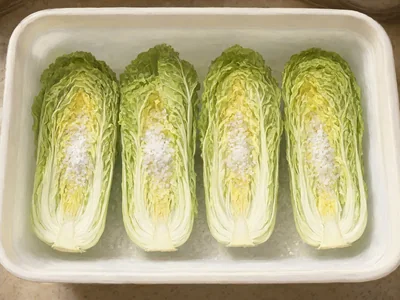
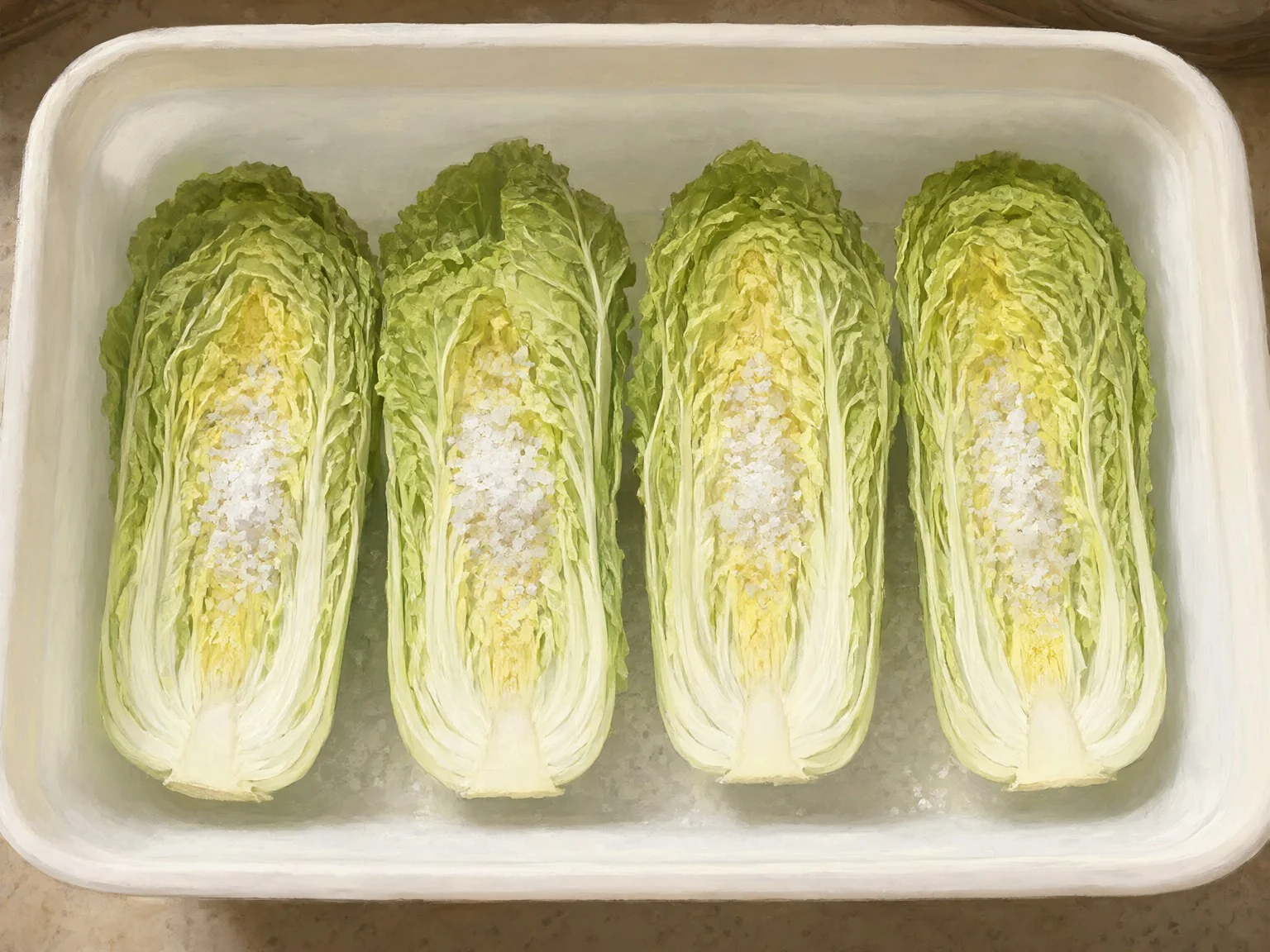
- Salt the cabbage. You’ll need two small heads of napa cabbage, about 6 pounds together, and one cup of coarse sea salt. Cut each head in half lengthwise and sprinkle salt between the leaves, with extra on the thick white stems, since they take the longest to soften. Leave it for six to eight hours, turning the pieces over once or twice. It’s ready when a white stem bends without snapping.
- Rinse the cabbage three times in cold water, then let it drain cut side down for about an hour.
- Mix the paste: half a cup of Korean chili flakes (gochugaru), 3 tablespoons of minced garlic, 1 teaspoon of grated ginger, 3 tablespoons of fish sauce, 1 teaspoon of sugar and four green onions cut into short pieces.
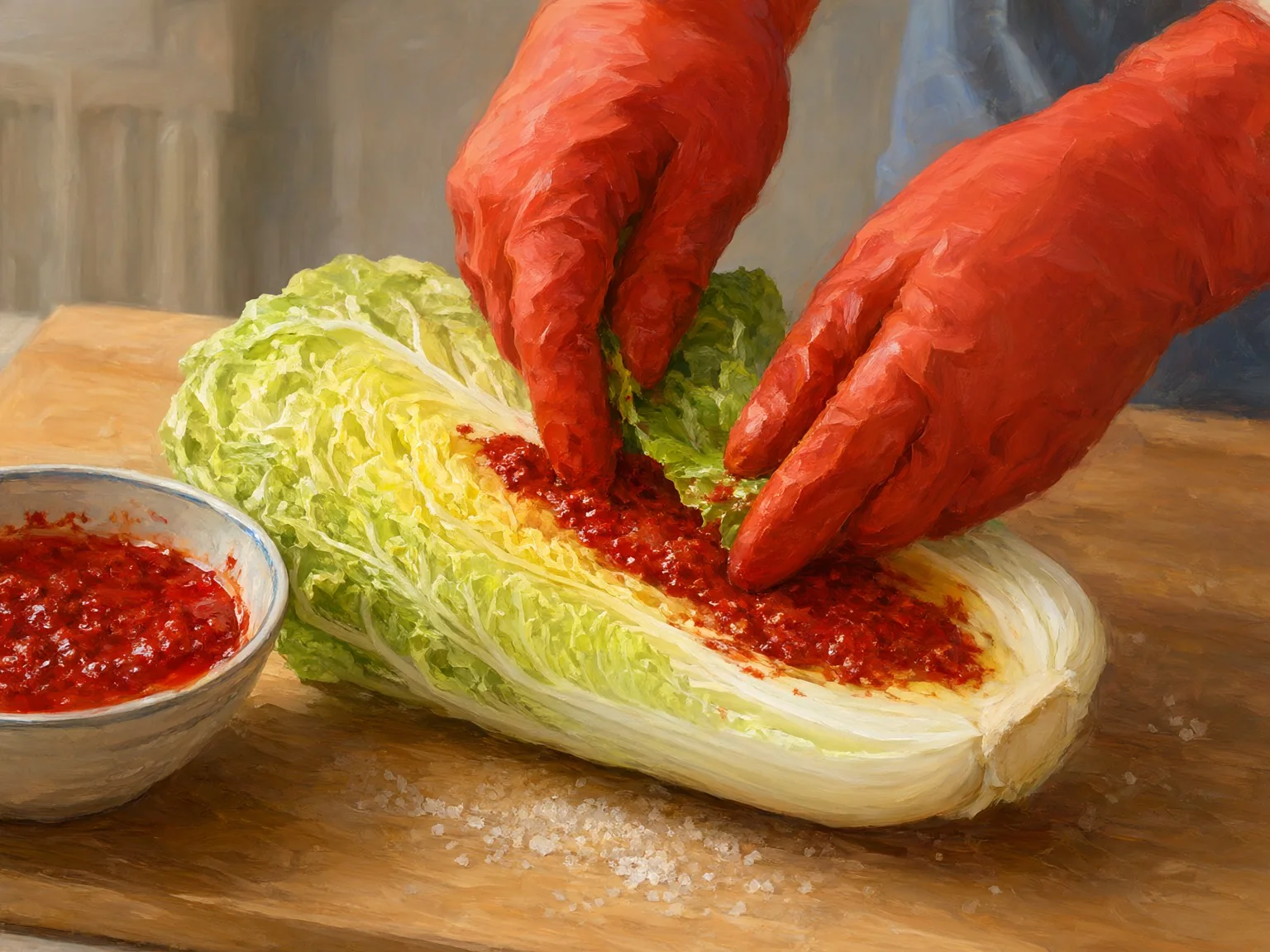
- Put on gloves for this part. Spread the paste between every leaf, fold each half over on itself and pack the halves into the jar. If they won’t fit through the mouth, cut them into quarters first. Press down hard until the liquid comes up over the cabbage, and leave about two inches of empty space at the top, because the kimchi rises as it ferments.
- Leave the jar on the counter for a day or two, then move it to the fridge.
Even with gloves on, my hands smelled of garlic until the next morning.
It took three bad batches to get to those five steps. After twenty years of sourdough and natto, I assumed cabbage would be the easy one. It wasn’t.
The first year, the kimchi went soft. I was afraid of making it too salty, so I used too little salt. It also happened to be a warm week, and the jar sat on the counter longer than it should have. By the second week, “crunchy” was no longer the word for it. Later I read that too little salt and too much warmth are the two most common reasons kimchi turns mushy. I’d managed both at once.
The second year, I went too far the other way, which is something I’m good at. I left the cabbage in salt all day and rinsed it only once. The kimchi was so salty you could only eat a little at a time. Much later I learned that mixing in some sliced radish helps pull a salty batch back. I didn’t know that then, so that jar lasted until spring, one small bite at a time.
The third year, a white film showed up on top. A few leaves had been sticking up above the liquid. It was most likely kahm yeast, a thin white layer that can form where kimchi is exposed to air. It’s harmless, but it looks alarming the first time you see it. If it had been fuzzy, or had green or black spots, that would have been mold, and the whole jar would have gone in the trash. I scraped off the film and the top leaves, and the kimchi underneath was fine. My nerves took longer to recover than the kimchi did. That’s why step 4 says to press until the liquid covers everything.
Here are this year’s notes for the first jar, copied from my notebook. I check how sour the kimchi is getting with cheap paper pH strips. The lower the number, the more sour it is. The strips aren’t very precise, so treat the numbers as rough.
- November 3: Packed the jar. pH about 5.5. It smelled of garlic and salt.
- November 4: Still on the counter. A few small bubbles showed up along the glass.
- November 5: More bubbles, and the liquid had risen. It tasted a little sour. pH about 5.0, so it went into the fridge.
- November 7: Properly sour now, and the cabbage was still crunchy.
- November 10: pH about 4.5. Sour and crunchy, just how I like it. A third of the jar disappeared over two dinners.
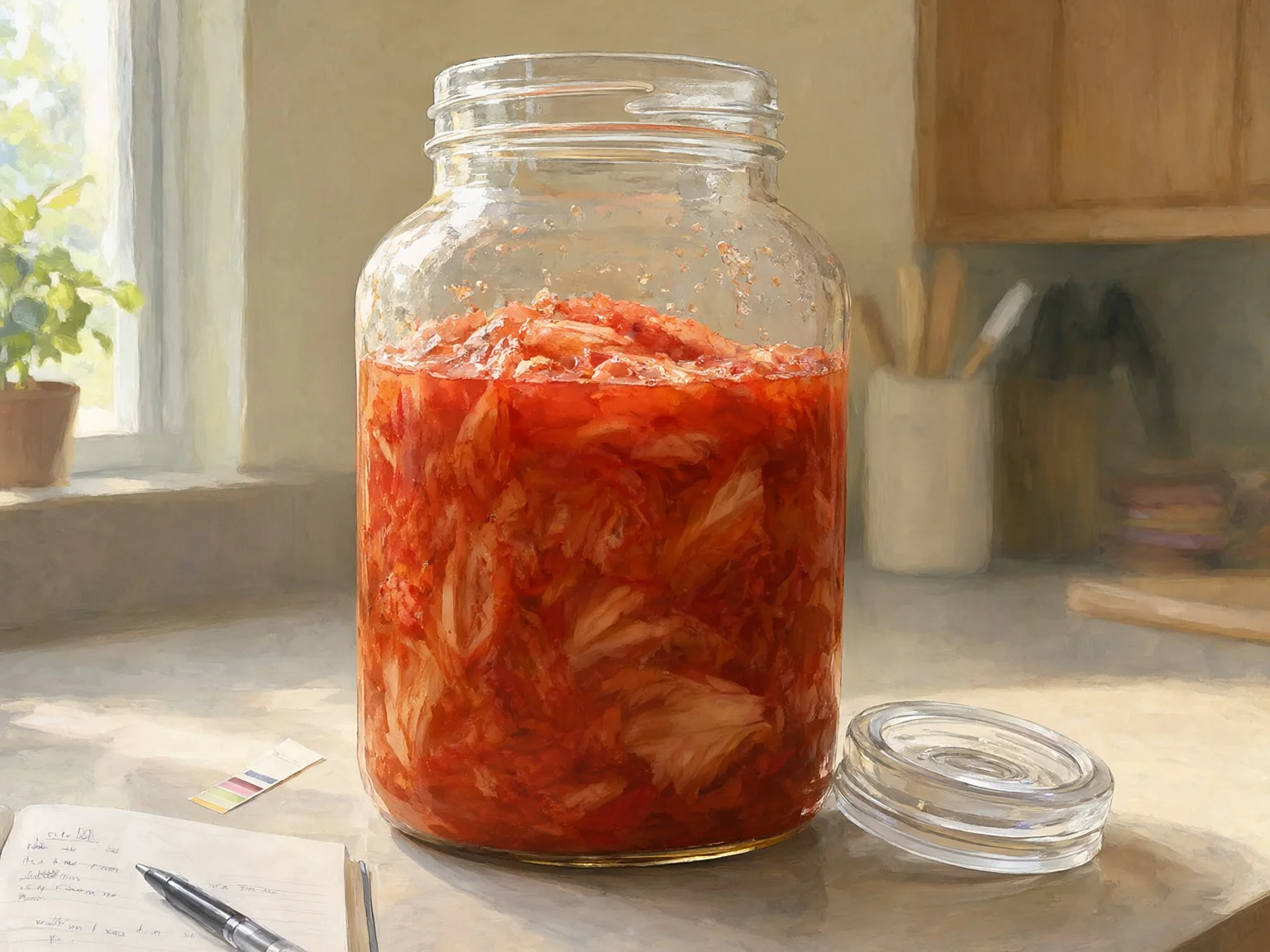
A few things I picked up from reading along the way. I don’t add any starter culture. The bacteria that do the work are already on the cabbage, the garlic and everything else. They use their enzymes to break down the natural sugars in the vegetables, and that makes acid (the sour taste) and carbon dioxide (the bubbles). Two research reviews I read name the same main bacteria: Leuconostoc, Lactobacillus and Weissella. I can never keep those names straight. What matters to me is that I don’t have to add anything.
One study gave numbers I could compare with my jar. Freshly made kimchi measured pH 5.6. Kimchi at its best was around 4.7, and kimchi that had gone too sour was around 3.8. My jar is a little past the best point and still far from 3.8. My first batch, I suspect, got there.
The fridge is what keeps it from going too far. On the counter, my jar changed noticeably every few hours. In the fridge, the same amount of change takes days.
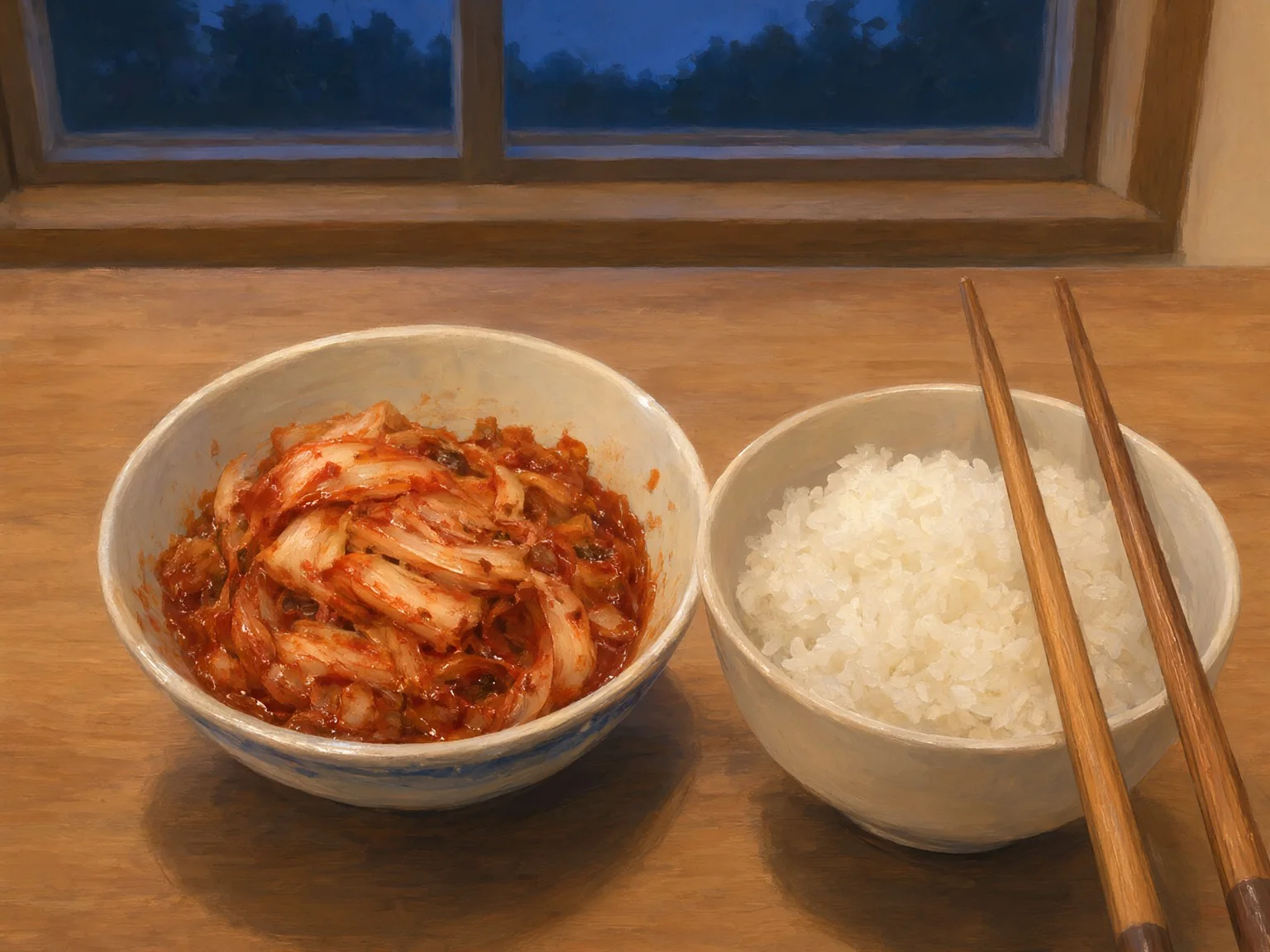
What I still want to find out is how long the rest of this jar will stay good before it gets too sour for me. I’ll test it with a strip once a week until it’s gone and write down what I find.
Sources
- ballmasonjars.com/blog?cid=kimchi
- ich.unesco.org/en/RL/kimjang-making-and-sharing-kimchi-in-the-republic-of-k…
- koreanbapsang.com/baechu-kimchi-napa-cabbage-kimchi
- tastingtable.com/1503178/mistakes-to-avoid-when-making-kimchi
- tastingtable.com/1703221/how-to-fix-salty-kimchi-radishes
- chowhound.com/stories/what-to-do-about-white-spots-on-your-kimchi
- maangchi.com/talk/topic/mushy-kimchi
- doi.org/10.1007/s00253-014-5513-1
- doi.org/10.1007/s00253-020-10804-8
- doi.org/10.1016/j.ijbiomac.2023.124905